Login

Don’t have an account?

Scroll Down.

AI Training and Coaching

Categories:

  • Role
    Lead Instructional Designer
  • Skills
    Prompt Engineering, Instructional Design, Marketing
  • Client
    Samsung Electronics
  • Year
    2024-2025

Project Overview

In this project, I was challenged to create a new training tool for an electronics company that utilized hundreds of online representatives from multiple regions in the world to provide 24/7 chat-based sales support to people shopping on their US web portal. To add to this challenge, most, if not all, of these online sales representatives were not native English speakers.  Historically, the management relied on a small group of “mystery shoppers” to evaluate the performance of these online sales representatives. “Mystery shopping” in a chat-based sales context is the practice of having trained evaluators pose as customers in live online chat interactions with sales representatives, assessing performance (for a minimum of 30-45 minutes per person)  by taking notes on each chat-based sales discussion, using a standardized rubric. The rubric measures how effectively the rep engages, recommends products, handles objections, and closes the sale. This reliance on a small, geographically limited evaluation team created significant training challenges for the team’s management. Feedback reached only a fraction of the workforce, was slow to arrive, and lacked both consistency and actionable detail. This also led to training challenges since training the remote sales workforce was relegated to a single trainer who had neither the time or the data to understand the diverse needs of the remote sales representatives.

To overcome these limitations, I created and deployed a system using AI-powered virtual coaches that simulated real customer interactions and acted as coaches to help them improve. These virtual AI coaches were developed as proof of concept as a safe and scalable training environment where sales representatives could practice continuously, make mistakes without risk, and refine their skills. I proposed the creation of a series of AI agents to act as coaches in a “virtual gymnasium” for professional development, providing immediate, rubric-based feedback on key skills such as active listening, product recommendations, and objection handling. For managers and the trainer, the system delivered clear, data-driven insights into team performance, allowing them to track trends, identify skill gaps, and improve overall sales readiness at scale.
In addition to virtual coaches and chat simulations, I created and deployed AI-powered virtual OLED TV experts capable of answering detailed product questions in real-timeduring customer chat interactions. These virtual AI experts were designed to supplement the written resource information online sales representatives were provided. The AI experts showed they could handle questions on complex specifications, features, and functions in seconds, enabling associates to ask questions and receive examples of good answers quickly, enabling them to practice real-world sales interactions to help them improve their sales skills in a fun and safe environment.

By integrating these virtual experts into the training ecosystem, sales representatives could refine their ability to respond quickly and accurately to customer inquiries in order to help them close more sales via chat. This could result in improved confidence and product fluency, but also provide managers with transcripts and performance dashboards to identify knowledge gaps and representatives with significant language challenges. The result was a more scalable, consistent, and data-driven approach to coaching online sales teams, ensuring sales representatives were better prepared to deliver clear, personalized answers that drive customer trust and sales conversions.

The Challenge

The company’s existing training model for online chat-based sales representatives was outdated and inefficient. Mystery shopping remained the primary evaluation tool, but it was slow, inconsistent, and resource-intensive. Only a handful of representatives could be evaluated each week, and the feedback provided was often delayed, vague, or difficult to translate into meaningful training or coaching. Most sales associates received little to no personalized training outside of corrective manager meetings, which tended to focus on underperformance rather than skill development. This lack of timely, actionable, and scalable feedback created barriers to building stronger customer interactions and improving sales outcomes across the organization.

The Process

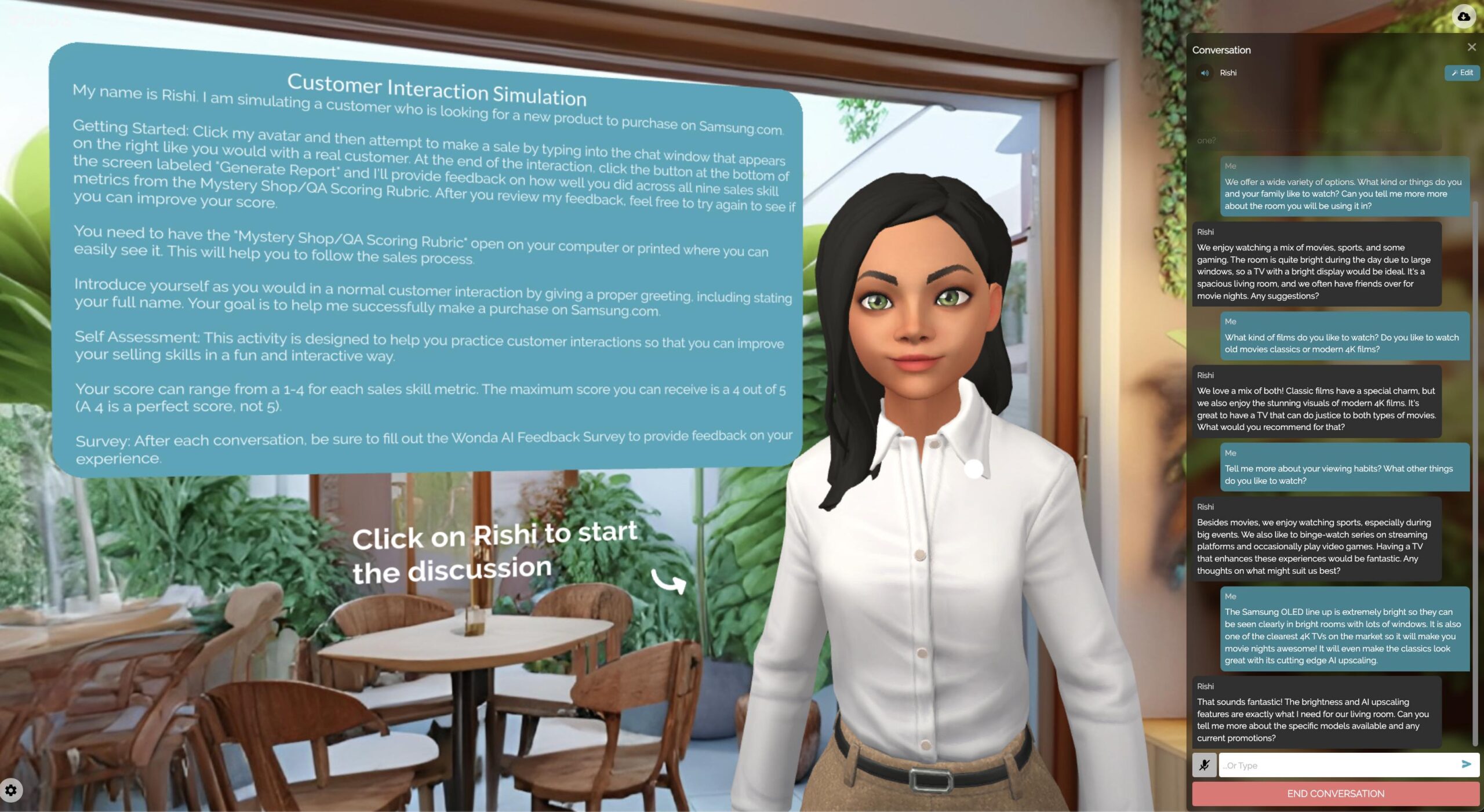
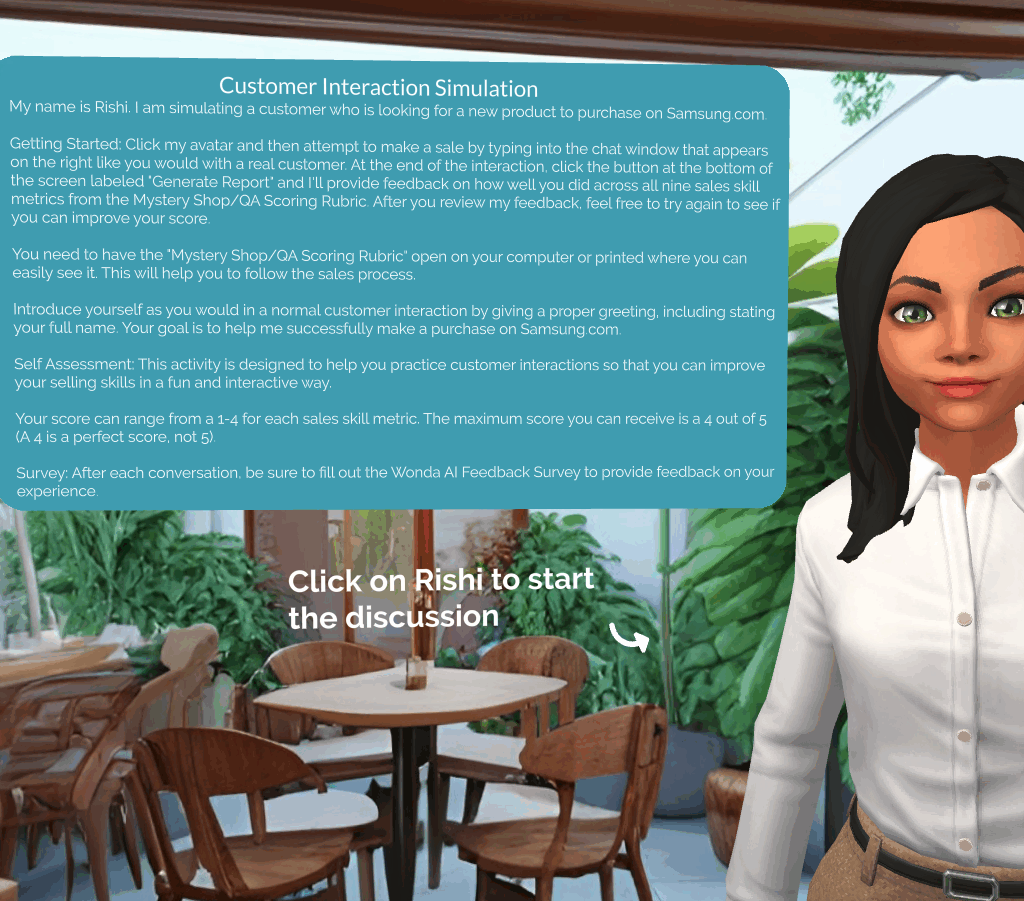
In order to meet this challenge, I developed an AI-powered training system that replicated real customer chat-based sales conversations. The solution integrated AI-driven virtual customer avatars that engaged sales representatives in role-play scenarios. This created a more engaging, game-like simulation where associates could practice handling inquiries, objections, and closing tactics in real time. They also receive personalized feedback from a virtual coach immediately. By using game-like avatars with visual representation, the experience felt more immersive and enjoyable compared to a text-only simulation.

AI Bot Development

I designed and engineered prompts to enable the AI customer avatars to simulate realistic customer conversations and objections, and I designed the AI experts’ to answer complex product questions. Over time, the AI avatars were trained to become more sophisticated in objection handling, allowing sales representatives to practice in environments that closely mirrored real-world customer interactions. The avatar-based design helped transform the training exercise into a dynamic, game-like experience, keeping engagement high and practice consistent.

Mystery Shopper Rubric Integration

To ensure training feedback aligned with existing evaluation standards, I partnered with the trainer and developers to integrate the same 9-point assessment rubric used by mystery shoppers. This rubric included:

  1. Opening the Conversation
  2. Active Listening
  3. Probing Questions
  4. Product Recommendations
  5. Handling Objections
  6. Cross-Selling
  7. Up-Selling
  8. Offers & Promotions
  9. Closing Tactics

Embedding this rubric into the AI-driven tool ensured assessments were measurable, actionable, and directly comparable to existing performance benchmarks.


Immediate Feedback & Coaching

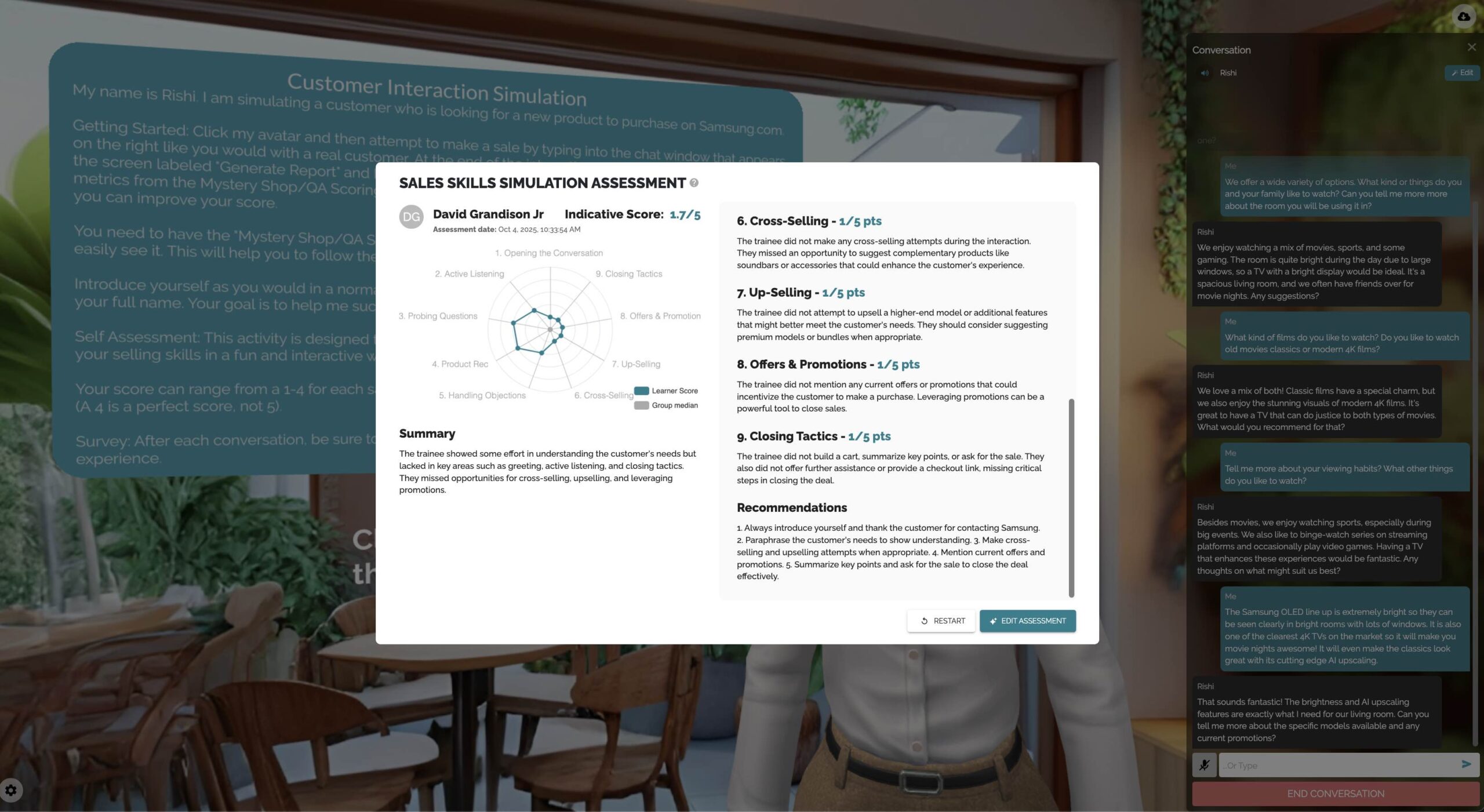
The training system was designed to provide instant, detailed feedback after each simulated conversation. Sales representatives could immediately see where they performed well and where improvements were needed, with visual and/or verbal guidance aligned to the rubric. This made feedback both specific and actionable, while also giving reps the chance to retry role-play scenarios and practice until mastery was achieved. 

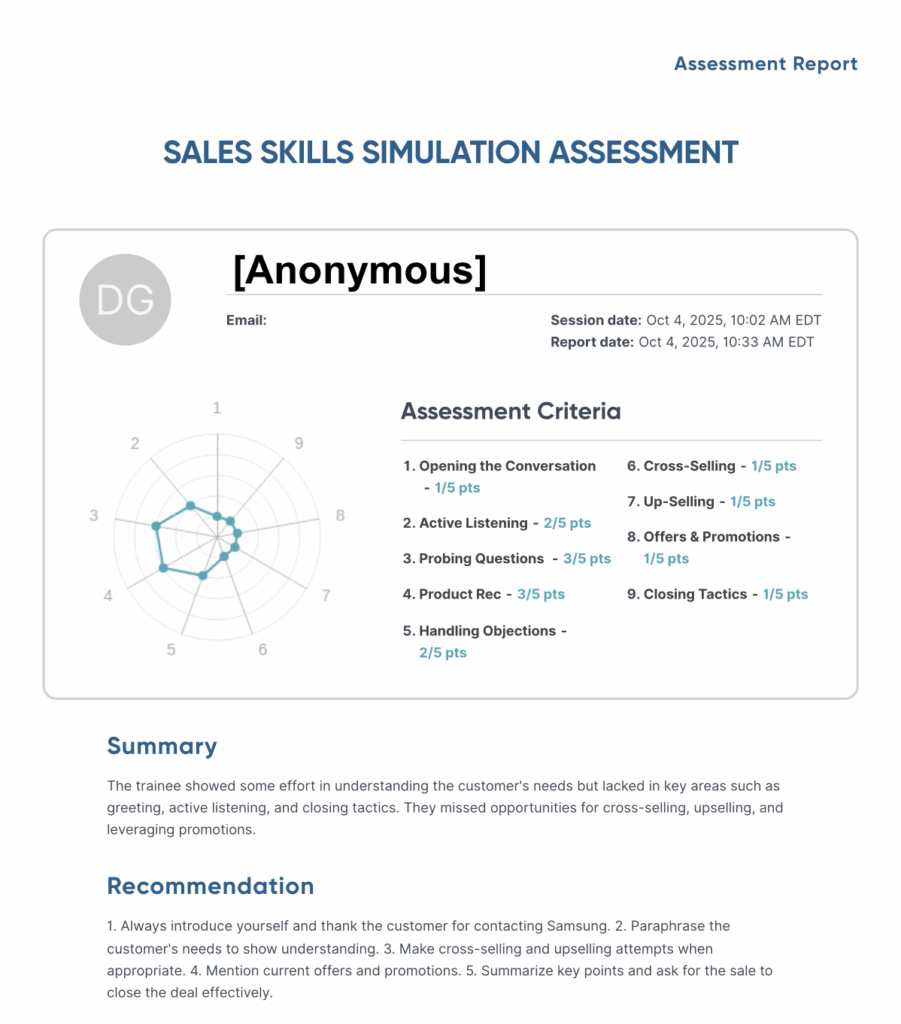
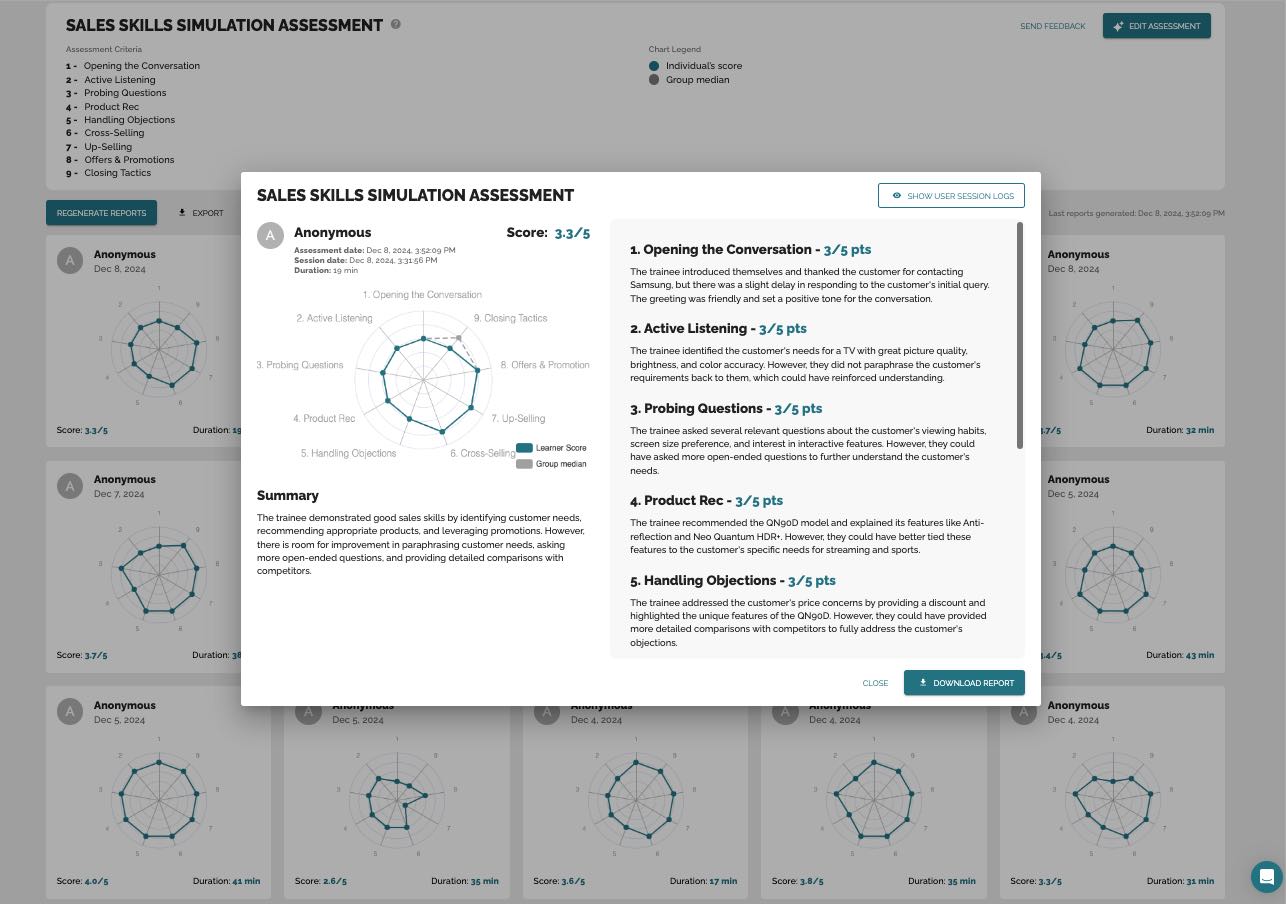
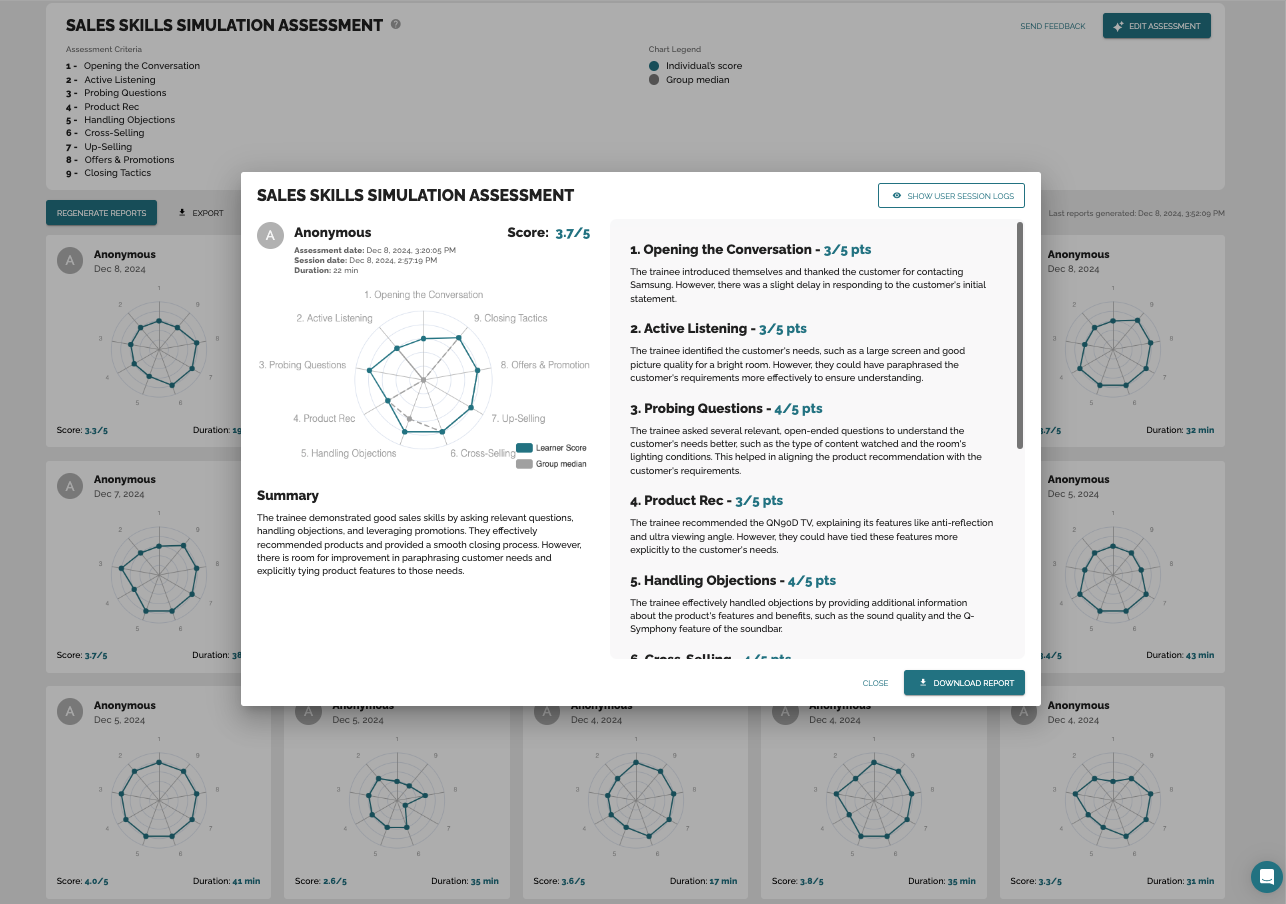
Here is an example of the detailed assessment report that was available to the trainee or management following a session with our AI coaching avatar.
Sales Skills Simulation Assessment
Click to view/download an example of a complete multi-page Assessment Report
Collaboration with Developer

I worked closely with the platform’s developer to enhance the system’s functionality so it could meet the company’s specific sales training needs. New prompts were written and iterated on to expand objection-handling practice, integrate product-specific scenarios, and refine the evaluation scale. These additions ensured the tool was contextually relevant and provided a robust framework for coaching at scale.

Dashboards & Analytics
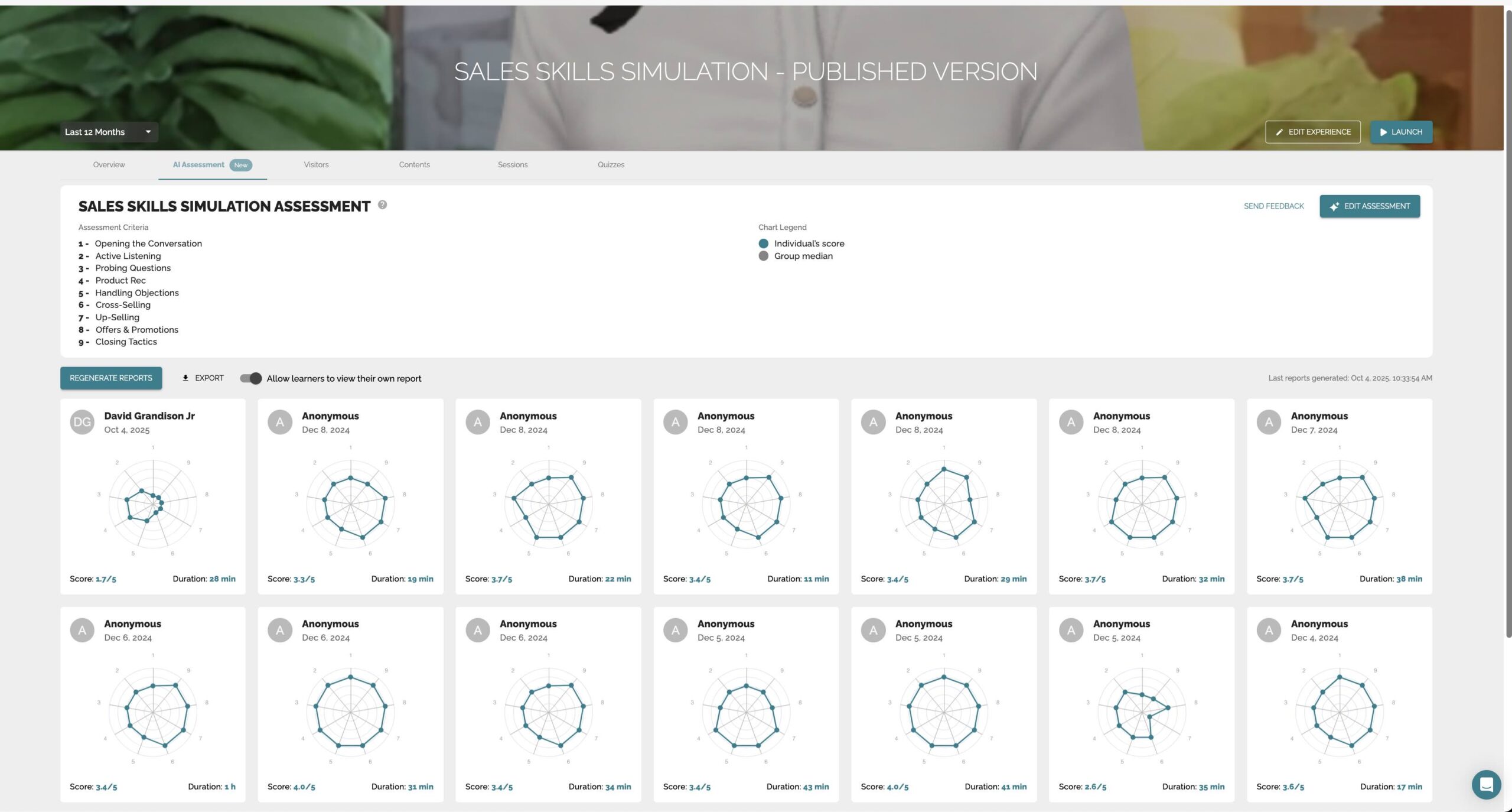
To support managers with assessments as evaluation data, the tool also offered a comprehensive dashboard that provided real-time visibility into performance at the individual level and across teams. The simple, visual interface allowed managers to quickly identify individual deficiencies or detect systemic trends across the workforce. These associates worked in different regions worldwide, often serving U.S. customers while speaking English as a second language. These dashboards revealed key issues such as language barriers among non-native English speakers, sales representatives relying on copy-pasted product details instead of paraphrasing and sharing information in natural conversation, and weaknesses in objection handling and closing tactics. With this data, managers could target training interventions at both the individual and group level, transforming performance reviews from anecdotal mystery shop reports into a consistent, scalable, and data-driven coaching system.

Project Outcomes

The AI coaching and training ecosystem I developed demonstrated how to transform the company’s approach to online sales training and coaching in several measurable ways:

  1. Scalability: Trained and coached hundreds of sales representatives simultaneously, eliminating the bottleneck of mystery shopping.
  2. Consistency: Delivered standardized, rubric-based assessments to ensure fairness and quality across all reps.
  3. Immediate Feedback: Provided real-time coaching and the ability to retry simulations, accelerating skill improvement.
  4. Manager Insights: Dashboards offered both individual performance and aggregate group data, making systemic issues and training effectiveness visible at a glance.
  5. Behavioral Impact: Revealed key problems such as over-reliance on website copy, poor objection handling, and unclear communication—enabling targeted remediation.
  6. Business Results: Improved sales readiness, boosted customer satisfaction in online channels, and contributed to measurable increases in conversion rates.

I created this initiative as a blueprint for scalable, AI-powered coaching and assessment. It reached the goal of demonstrating how a single trainer with the help of virtual AI coaches and AI experts could create a continuous learning loop that was more engaging and effective, reaching hundreds of sales representatives, and the data generated was more actionable for our training team and management. It showed the potential of AI not just as a training tool, but as a catalyst for cultural and behavioral transformation in online sales organizations.

One of the most transformative impacts of this initiative was shifting from the limited, ad hoc mystery shopper model to a scalable, data-driven approach. While mystery shoppers provided anecdotal, one-off evaluations of a handful of sales representatives each week, the AI-driven system allowed every associate to be assessed regularly and consistently. This large-scale visibility enabled leadership to identify patterns across entire teams rather than reacting to isolated incidents. Managers could now use dashboards to compare individual, group, and organizational performance against standardized benchmarks, making it easy to spot systemic weaknesses like objection handling or language barriers. This level of data-driven insight not only enabled the company to accelerate the pace of training improvements but also ensured that coaching interventions were timely, targeted, and measurable—something that the traditional mystery shopper model could never achieve.

Urban Universe Productions

Immersive interactive learning experiences